
|
A Research Paper for Missiological Homiletics |
|
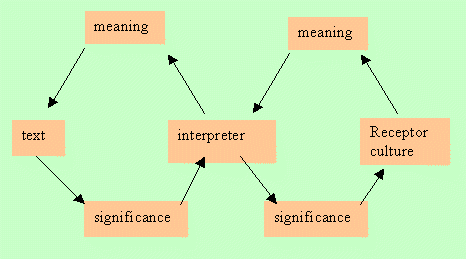
A MISSIOLOGICAL UNDERSTANDING OF PREACHINGGustaf Wingren indicates that kerygma in the New Testament is undeniably missionary preaching when he states, "The preaching in the New Testament gives us no information at all about the preaching that took places within the congregation. The kerygma was itself missionary preaching, in Dodd’s phrase ‘the public proclamation of Christianity to the non-Christian world'" (1960:47). In Willimon and Hauerwas' term, it is conversion that every genuine preaching should seek for. They say, “Our preaching to the unbaptized must aim for conversion rather than mere agreement, evangelism rather than apologetics” (1994:40). Bill Hybels, the pastor of Willow Creek Church, convinces us that there is a kind of preaching that attract non-Christians, keeps them coming back, and leads them to take the momentous step of following Jesus Christ (1990:24-25). For instance, he urges the need for 'developing sensitivity' viz. 'Understanding the way the non-Christian audience think.' "As we learn the way non-Christians think and develop a genuine love for them, we can speak the words of Christ in a way they'll hear" (:29-31). Lesslie Newbigin support this argument from his cross-cultural perspective. He observes that “the movement of the gospel from its articulation in the language and practice of Greek-speaking Communities” in the New Testament provides us with the model of gospel communication across a cultural frontier. Expounding the twenty-sixth chapter of Acts, he affirms that “The communication has to be in the language of the receptor culture. It has to be such that it accepts al least provisionally, the way of understanding things that is embodied in that language” (1986:4-6). The message of preaching is delivered across cultures. It is delivered from the biblical to contemporary world, from the church to non-church culture, or from a culture to another. Missiologically speaking, we need to build a communication bridge for the powerful communication of the gospel that incites conversion from the hearts of the hearers. Missiological Understanding of Preaching from the New Testament PerspectiveThere are some striking similarities between the preaching of the prophets and that of the Apostles: Both represented God, both spoke His Word, both understood God’s Word to be God’s deed. Sidney Greidanus, however, notes one difference between the preaching of the prophets and that of the apostles. Aside from the contents, the difference lies in the sources used for their preaching. Whereas the prophets usually received the Word of the Lord usually via vision, dream, or audition, the Apostles usually based their preaching on what they had “seen and heard” (1Jn. 1:3). The Word made flesh in fulfillment of the Scriptures. As such, their preaching moved toward exposition of the Scriptures (1988:5-6). In short, the prophets preached from revelation, the Apostles proclaimed from interpretation. With Gustaf Wingren, the Swedish theologian, the missionary motif of the Bible is highly emphasized. According to him, the Word of God does not exist by itself. It exists to be heard; it exists in order to be proclaimed to people. A Bible sitting on a shelf is of absolutely no use. The Bible’s word is useful and creative only as people read and hear. The Word of God exists for people to hear (Jensen 1980:68). In Romans 10:15 we read, “And how can they preach unless they are sent?” The two words ‘sent’ and ‘preach’ in the verse have missiological implications for preaching office. The fact that 'sent' is linked with 'preach' elsewhere in the New Testament is no accident. It belongs to the very nature of things. Without commissioning and sending there are no preachers, and without preachers there is no proclamation. True proclamation does not take place through Scripture alone, but through its exposition.[1] Thus, in Luke 4:21, we see Jesus saying, “Today this scripture is fulfilled in your hearing” as He began his interpretation of Isaiah in the synagogue. God does not send books to men; He sends messengers (Friedrich 1965:712). This indicates that the preacher is a messenger who's commission is to deliver the message he or she received and interpreted. Friedrich expounds that Jesus proclaimed what he exposed. Jesus did not give theoretical teaching when He spoke in the synagogue. He did not expound Scripture like the rabbis. He did not tell people what they must do. His teaching was proclamation. He declared what God was doing among them today: This day is Scripture fulfilled (Lk. 4:21). His exposition was a herald's cry. His teaching concerning the coming of the kingdom of God was an address demanding decision either for it or against it. Hence, His preaching was very different from that of the scribes at synagogue worship (:713). Preaching as a Cross-cultural CommunicationGrant R. Osborne observers that what missiologists call “contextualization” is identical with what homileticians call “application.” He defines contextualization as that dynamic process which interprets the significance of a religion or cultural norm for a group with a different cultural heritage. At the heart it entails cross-cultural communication (1991:318). This implies that preaching is a cross-cultural communication, or in a dynamic sense a missionary proclamation. Osborne maintains the preacher/missionary has the dual role first as interpreter and then as Proclaimer (1991:325).[2] Figure 1 is the illustration of the preacher/missionary’s dual role between the biblical text and the culture of the message receptor.
_________________________________________________________________
|
|||||||||
Research Notes |
Missiology Bookstore |
Favorite Links





 ©
This article is originally an excerpt from Dae Ryeong Kim's paper, "Hermeneutics for Missionary Preaching."
©
This article is originally an excerpt from Dae Ryeong Kim's paper, "Hermeneutics for Missionary Preaching."